The
Trophy
91 Winners. 90 Years. One Question.
The definitive documentary series about college football's most iconic award — and the men who carried it home. Three episodes. Nine decades. The stories behind the story.
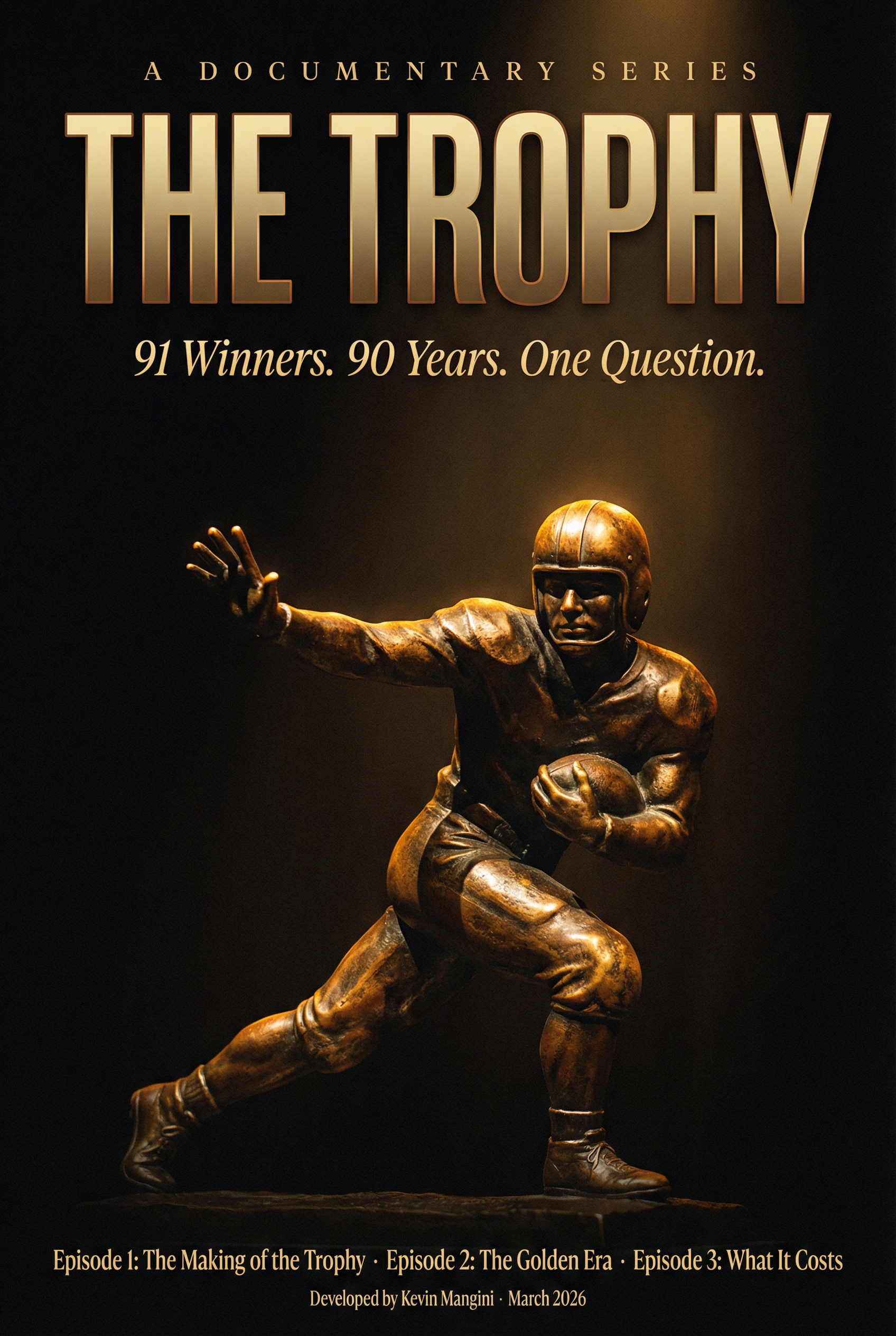
Key art is conceptual. Casting not final.
Not a Highlight Reel.
A Human Story.
The Heisman Trophy is the most recognized individual award in American sports. But this film is not about the award. It is about what the award reveals — about the players who won it, the eras that shaped it, and what it has meant to be the best college football player in America across nine decades of a changing country.
"For 90 years, one award has held a mirror up to American football, American culture, and the American dream. This is what it reflected back."
This is a portrait of ambition, pressure, identity, and legacy — told through the stories of the men who carried the trophy home. For the first time, they're telling it in full.
What did winning it actually mean?
The award is given in December. Life happens in everything that follows.
Three Eras.
Three Episodes.
The Making of the Trophy
The award finding its identity alongside America. From Jay Berwanger — who never played a professional game — through Nile Kinnick, who died at 24 in a Navy training accident, to Ernie Davis, the first Black winner. The trophy as a mirror for who gets to be seen as excellent in America.
The Golden Era
The trophy at the height of its cultural power. Tony Dorsett carries Pittsburgh on his back. Bo Jackson becomes American mythology. Barry Sanders has the greatest individual season in college football history — quietly. Charles Woodson beats Peyton Manning.
What It Means
What fame does to young men. The trophy in a world it wasn't designed for. Ricky Williams disappears into something entirely his own. Tim Tebow becomes a cultural symbol. Johnny Manziel is consumed by the moment. Lamar Jackson is told to switch positions. Travis Hunter plays both ways in the NIL era.
Fifteen Windows.
Ninety Years.
Each story chosen because it illuminates something larger than football.
One Question.
The Award Was Designed
for a Different Era.
NIL has fundamentally changed what it means to be a college athlete. Players are now brands, businesses, and public figures before they ever turn professional. The transfer portal has changed what loyalty means. The relationship between excellence, fame, and identity has never been more complicated.
Travis Hunter winning the 2024 Heisman as a two-way player and full-time brand is the most interesting possible ending to a 90-year story that began with Jay Berwanger — a man who won the first trophy and walked away from professional football entirely. The distance between those two moments is the film.
No one has told the definitive story of this award. Not as a celebration — as an honest portrait of what excellence means across nine decades of a changing country, and what it feels like to be the best at something before your life has really begun.
Where This Lives.
ESPN has been the exclusive home of the Heisman Trophy Ceremony since 1994. ABC aired the ceremony for the first time in 2025. The archive relationship, existing broadcast partnership, and ESPN's college football authority make this the clearest path to production — and the most coherent extension of what ESPN already owns.
The Last Dance association is an immediate signal of the series' ambition and scale. Netflix's global reach and appetite for definitive sports documentaries make this a strong second path.
An expanding sports portfolio and the Thursday Night Football audience provide a reasonable strategic fit for a college football documentary of this scope.
Nissan
Nissan has sponsored the Heisman ceremony since 2014. The Trophy extends that relationship beyond a single night — three episode franchises, each an ownable brand moment built from the award they already own. The presenting sponsorship becomes the defining one. The long form is only part of it. A series of this scale generates significant short-form and social content across YouTube and Instagram. Nissan's presence in the documentary travels with every clip.